Characteristics of Gas

This layout is based on the layout skyline from CreateBlog.

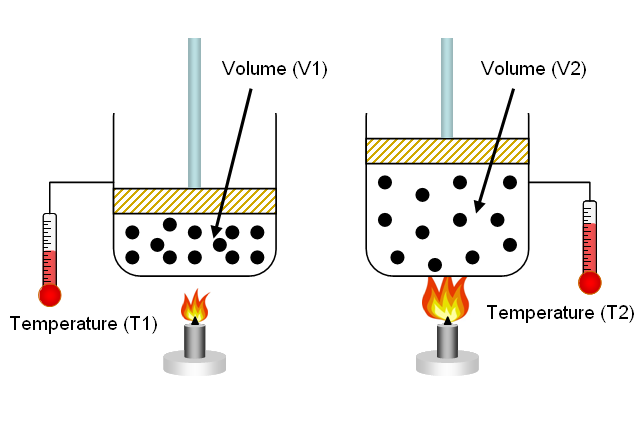
In this beginner-friendly introduction to gases, it is important for who are students taking chemistry to have a good understanding of the three common states of matter. The most common states of matter being solid, liquid, and gas. In this specific section, we will be going over the Characteristics of gas. In this state of matter, gases take the shape of whichever container they are in. Whether it is a star-shaped container or a glass beaker, the gas will be able to take its shape. The reason behind this is that gas is the “highest energy form” of matter, meaning that the gas particles are so energetic that they stay in constant motion. So the gas particles are constantly moving and filling in as much space as they can in the container they have been put in. It is also known that gases have no fixed volume; however, compression can change the volume with different pressures and temperatures. According to Charles’s Law, if we were to heat up a container that was filled with gas, not only would the volume increase, but so would the temperature, since they are directly proportional.

Compression, for example, can be shown as a gas filling a cylinder container with an airtight lid sealed at the top. Once the lid is pressed further down, the gas molecules are forced to become more and more compressed. This, in turn, increases the pressure inside of the container because of how little room they have to move. Now, if you were to lift the airtight lid back up, then the gas has a lot more room to fill up. This lets the gas take up much more volume than it did when it was compressed.

Boyle's Law

Gases are also known to have very low densities, typically about "1,000 times less dense than liquid or solid phases". This just shows how the particles in the gas spread out more compared to the other matter. Another way to better understand this is by the formula of Density = mass over volume. In this way, we can understand that density equals the amount of mass, and since gas has such a low density, it must have a small amount of mass compared to liquids or solids.

Gases also happen to have an immense amount of pressure against the walls of the containers they are inside of. This pressure is due to the constant motion of the gas particles are in and bump into the walls of the container. There are also a total of four pressure gauges. One of the pressure gauges can be found on the top of the container, another one on the bottom, and this leaves the other two to be on one of the remaining sides. By this setup, the four pressure gauges have the same amount of pressure, so the gas pushes equally in all directions against the container's walls.

Now that we have covered the characteristics of Gases, it’s time we learn about the Particulate-level explanation of the characteristics of gases.

Explanation of Gas characteristics

Scientists classify natural gases by studying four main features: the amount of heavier hydrocarbons (called C₂⁺ gases), and the carbon and hydrogen isotopes in methane and ethane. These measurements act like a “fingerprint,” helping researchers figure out how the gas formed. Using these properties, scientists can identify whether a gas was made by bacteria near the surface (biogenic gas), by heat and pressure acting on deep organic material (thermogenic gas), or if it is a mix of both types. These classifications are based on data from around 500 natural gas samples collected from many different geological areas.

Even when gas moves through rock layers over long distances, its isotopes usually stay the same. This makes it possible to tell where the gas originally came from, even if its C₂⁺ content was changed during migration. Real-world examples from the Gulf of California and basins in Germany, Austria, and Italy show how this method clearly separates bacterial gases, thermogenic gases, mixed gases, and gases that have migrated from their source (AAPG, 1983).

All matter exists as a solid, liquid, or gas, and the differences between these states depend on how strongly their particles attract each other. Gases have the weakest attractions, which means their particles are far apart, move quickly, and spread out to fill any container. This gives gases low density and high compressibility.

Liquids have stronger attractions between particles, so they stay close together, making liquids dense and mostly incompressible. However, liquids can still flow and change shape based on their container. Solids have the strongest attractions, with particles locked into fixed positions, making solids firm and rigid.

The state of a substance changes depending on temperature and pressure. Water is a familiar example because we often see it as ice, liquid water, or water vapor. Many elements—like oxygen, nitrogen, and the noble gases—exist as gases at room temperature because their particles stay widely spaced and free-moving under normal conditions (General Chemistry Source).

A gas has no fixed shape or definite volume. Its particles move quickly and spread apart naturally, so a gas expands to fill the entire space available. This is why gases can be squeezed (compressed), flow easily, and spread out rapidly in all directions.

You see this in everyday life: steam rising from boiling water, oxygen flowing through medical tubes, or helium spreading throughout a balloon to fill it evenly. The air around us is a mixture of different gases, mainly nitrogen and oxygen, along with small amounts of others. To measure gas volume, scientists might trap the gas in a container or calculate it using pressure–volume relationships (YouTube Educational Video).

Boyle's Law

Natural gas hydrates are solid, ice-like substances made when water molecules form cage-shaped crystals that trap gases, mostly methane. They form only under cold temperatures and high pressures, such as in the deep ocean or frozen Arctic ground. Hydrates look like ice but are different because they stay solid even at warmer temperatures as long as pressure remains high.

Hydrates can fill spaces between sediment grains, form nodules, or act like cement that strengthens the surrounding sediments. They store a huge amount of methane—one cubic meter of hydrate contains about 164 cubic meters of methane gas. Because hydrates are very sensitive to temperature, pressure, and salinity, they can form or break down quickly when environmental conditions change. Understanding how hydrates grow, dissolve, or become unstable is important for studying climate change, seafloor stability, and future energy resources (Kvenvolden 1993; Sloan 1997; Max 2003).

Volume and Temperature

Understanding how gasses act under different conditions is fundamental in chemistry. One of the most important relationships is between volume and temperature, a rule by Charles’s Law. This law says that at constant pressure, the volume of a gas is directly proportional to its temperature in kalvin. In other words, if you heat up a gas it expands, if you cool it down in contracts.

Boyle's Law

Charles’s Law formula V1/T1=V2/T2. V is volume and T is temperature in kalvin. This equation allows scientists to predict how a gas will respond to temperature changes. For example, if the temperature of a gas doubles, its volume also doubles, assuming pressure and the amount of gas stays the same (Physics Classroom, Lesson 2: Gas Laws, Part b: Volume and Temperature).

This principle has everyday life applications. For example, a hot air balloon, when that air inside is heated the balloon expands, which decreases its density and allows the balloon to rise. The opposite also happens, cooling the air causes it to contract and make the balloon descend. This behavior is very important when designing engines, weather balloons, and even in understanding how our lungs expand and contract with temperature changes.

The relationship between volume and temperature is also important in industrial settings. In chemical manufacturing, exact control of a gasses volume is important to ensure safety and efficiency. For example, gas cylinders used in labs and factories must be stored at regulated temperatures to prevent dangerous expansions. Refrigeration systems also rely on the behavior of gasses under temperature changes. By compressing and expanding refrigerants, these systems transfer heat and keep the desired temperature in vehicles, homes, and medical equipment. French scientist and balloonist, Jacques Charles, first observed this relationship in the late 18th century. Though his findings were not published immediately, they were later confirmed and legitimized by Joseph Louis Gay-Lussac in 1802 (Wikipedia, Charles’s Law). Charles’s experiment involved measuring the volume of gasses at different temperatures while keeping the pressure constant. His observations are the foundations for modern day gas laws.

It's also important to note that this relationship only holds when pressure is constant. If pressure changes, other gas laws should be considered like; Combined Gas Law or Boyle’s Law. Boyle’s Law for example, is the inverse relationship between pressure and volume at a constant temperature, as temperature increases, volume decreases (LibreTexts, 6.3 Relationships among Pressure, Temperature, Volume, and Amount).

In lab settings, Charles’s Law is often shown using balloons or sealed syringes placed in hot and cold water. As the temperature changes, the volume of the gas inside visibly expands or contracts. These experiments reinforce the idea that gas particles move faster and spread out more when they are heated, taking up more space.

Overall, Charles's Law provides a clear and predictable model for how gases respond to temperature changes. This direct proportionality between volume and temperature is a foundation of thermodynamics and helps explain many natural and formulated phenomena. Whether we are inflating a flat tire, launching a balloon, or studying respiration, understanding this law is essential.

Volume and Pressure

From my research on Volume and pressure, I have found that in chemistry, gases are very important in chemistry, and it is necessary to understand how pressure and volume influence each other. Gases, as we all know, are a state of matter with no definite shape, volume, and are colorless. Gases have particles that are widely spaced within a constant motion going in all directions. Boyle’s law illustrates that for a fixed amount of gas at a constant temperature, the pressure of a gas is proportional to its volume. Since pressure and Volume are constant, when pressure increases, volume decreases. When volume increases, pressure decreases, and what I have just described is called inverse proportionality.

Boyle's Law

In addition to my research, the correspondence between volume and pressure can be understood by looking at how gas particles behave inside a container. Volume(v): the amount of space a gas occupies, and pressure(P): the force of a gas excerpt on the container walls. Pressure can be measured in atmospheres (atm), pascals(Pa), or millimeters of mercury (mmHg). For example, in a smaller container, gas particles have less space to move around, which allows them to collide with the walls of the container more frequently, resulting in higher pressure. However, when the container expands, gas particles have more distance to expand and move out, leading to fewer impacts and lowering the total amount of pressure. This way, the gas molecules don’t constantly bump into the walls of their container.

Boyle's Law

For example, in medicine, syringes also depend on Boyle’s law in order to extract liquid, a fun fact I learned while doing research. When you pull back the plunger of the syringe, the volume inside the chamber increases, thus decreasing the internal pressure. This creates a low-pressure vacuum internally. The greater atmospheric pressure on the exterior draws the fluid inward. For another example, in comparison to the human body, during inhalation, the diaphragm contracts and lowers, it increases the internal volume of the chest cavity, expanding your lungs in the process. When internal pressure in the lungs falls, higher atmospheric pressure forces the air into the lungs.

From my research on Volume and pressure, a different analogy could be for scuba divers, as understanding Boyle’s law is essential for safety. For example, as the scuba diver descends further and further into the water, the increase in water pressure compresses the air held in the lungs and equipment. When drivers ascend, there is a change in the air in the lungs and equipment. When drivers ascend, the air in the lungs expands; however, if a scuba diver were to ascend too fast, then the lungs would over-expand, which, in turn, can cause the tissues of the lungs to rupture since they are stretched beyond what's physically possible. Divers also use Boyle’s law in many situations and even while doing simple tasks, depending on how pressure and volume change with depth.

Presentation i think

Presentation link or uploaded here.

parody video

parody video link.